
 EN
EN
Electrical surges are among the most unpredictable and destructive events that industrial facilities, commercial buildings, and residential installations face. A single transient overvoltage event can destroy sensitive electronics, damage wiring insulation, and trigger costly downtime that ripples across entire operations. Understanding how a surge protective device works to intercept and neutralize these voltage spikes is essential for anyone responsible for maintaining electrical system integrity.
A surge protective device system does not simply absorb excess energy in isolation. It operates as a coordinated layer of protection within a broader electrical architecture, diverting harmful transient currents away from connected equipment and toward a safe ground path. When properly selected, installed, and maintained, a surge protective device reduces the probability of equipment failure, extends asset lifespan, and supports the continuity of critical processes. This article explains the mechanisms, system logic, and practical considerations that make surge protection an indispensable part of modern electrical risk management.
The Mechanism Behind Surge Protective Device Operation
How Transient Overvoltages Enter Electrical Systems
Transient overvoltages originate from two primary sources: external events such as lightning strikes and utility switching operations, and internal events such as motor starts, capacitor bank switching, and load changes within a facility. These events generate voltage spikes that can reach several thousand volts within microseconds, far exceeding the rated tolerance of most electrical and electronic equipment.
When a lightning strike hits a power line or a nearby structure, the resulting electromagnetic pulse couples into the electrical network and propagates through conductors at high speed. Utility switching operations, while less dramatic, introduce repetitive low-level surges that accumulate degradation in insulation and semiconductor components over time. Both categories of transient overvoltage represent genuine threats that a surge protective device is specifically engineered to address.
Internal surges are often underestimated. Large inductive loads such as motors, transformers, and HVAC compressors generate back-EMF spikes when switched off. These internally generated transients travel through the same wiring that feeds sensitive control systems, PLCs, and communication equipment, making in-facility surge protection just as important as protection against external events.
The Core Clamping and Diversion Process
The fundamental operating principle of a surge protective device relies on voltage clamping. When the voltage on a protected conductor rises above a defined threshold, the device activates and creates a low-impedance path to ground, diverting the excess current away from connected loads. This clamping action limits the voltage that downstream equipment actually experiences, keeping it within safe operating bounds.
Metal oxide varistors, or MOVs, are the most widely used clamping components inside a surge protective device. They exhibit a highly nonlinear resistance characteristic: under normal voltage conditions their resistance is extremely high and they pass negligible current, but when voltage exceeds the clamping threshold their resistance drops dramatically, allowing surge current to flow through them and into the ground conductor.
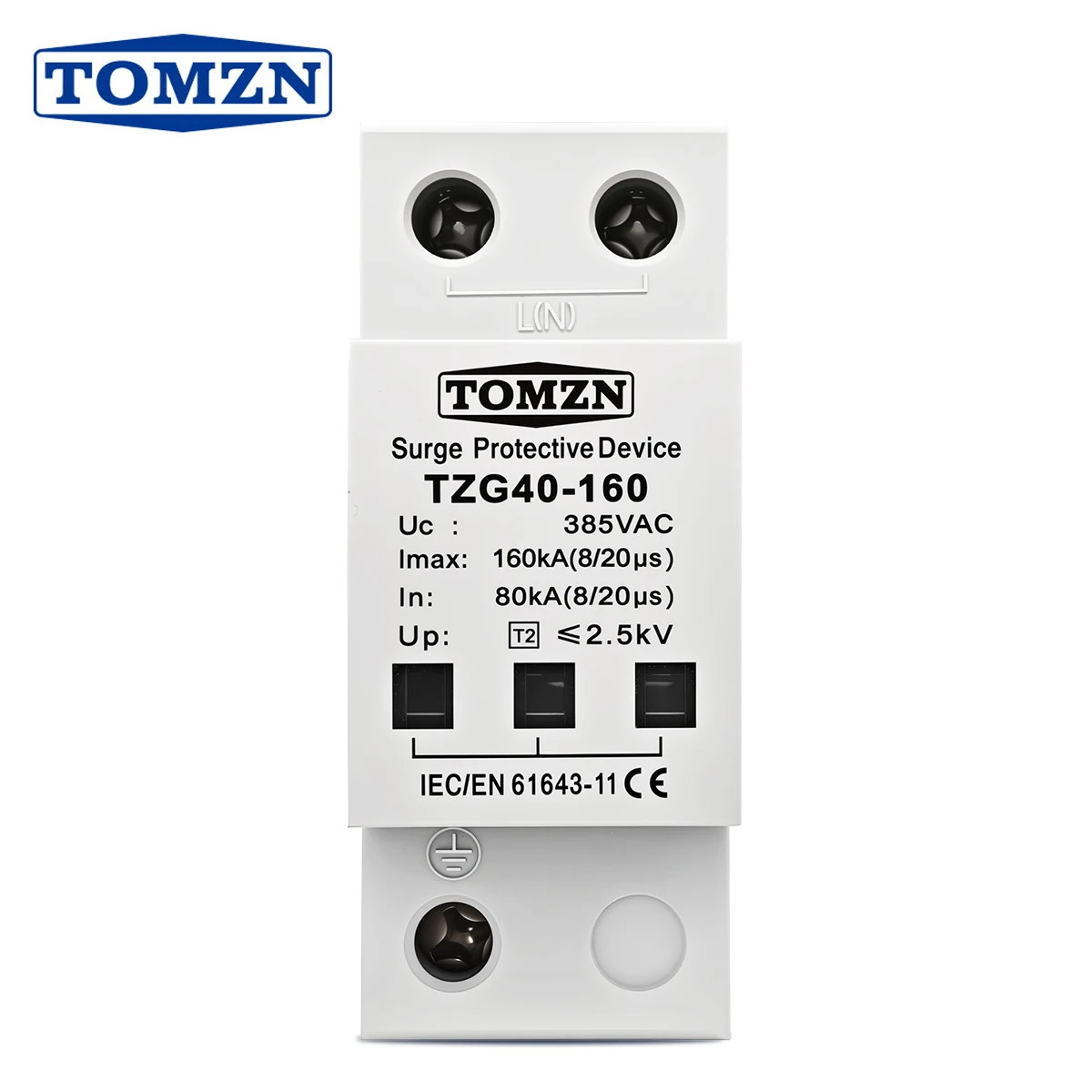
Spark gap technology and transient voltage suppression diodes are also used in surge protective device designs, often in combination with MOVs to handle different portions of the surge waveform. High-current models rated at 120kA, 160kA, or 200kA use robust component arrays to handle the most severe lightning-induced surges without failing catastrophically, ensuring the device remains functional after multiple surge events.
System-Level Surge Protection Architecture
Coordinated Protection Across Multiple Levels
A single surge protective device installed at one point in an electrical system rarely provides complete protection. Industry standards and engineering best practice call for a coordinated, multi-level approach in which surge protection is deployed at the service entrance, at distribution panels, and at the point of use. Each level handles a different portion of the surge energy, progressively reducing the transient voltage as it travels deeper into the facility.
At the service entrance, a Type 1 or high-current surge protective device handles the largest surge currents associated with direct or nearby lightning strikes. These devices are rated for impulse currents in the range of tens to hundreds of kiloamperes and are designed to absorb the bulk of the incoming energy before it reaches internal distribution equipment.
At the distribution panel level, a Type 2 surge protective device provides a second layer of clamping, addressing residual surges that pass through the first level as well as internally generated transients. At the equipment level, a Type 3 device or point-of-use protector handles the fine-level protection needed by sensitive electronics. This layered architecture ensures that no single device is overwhelmed and that protection remains effective across the full range of surge scenarios.
DIN Rail Mounting and Integration in Modern Panels
Modern surge protective device units designed for DIN rail mounting integrate cleanly into standard distribution boards and control panels without requiring significant additional space or custom enclosures. DIN rail compatibility simplifies installation, reduces labor time, and allows the device to be positioned close to the equipment it protects, which minimizes the length of the ground conductor and improves clamping performance.
A compact DIN rail surge protective device also supports modular panel design. When a device reaches end of life or sustains damage from a severe surge event, it can be replaced quickly without disturbing adjacent components. This maintainability is a practical advantage in industrial environments where minimizing downtime is a priority.
For telecommunication and signal line applications, specialized surge protective device models are available that address the lower voltage and current levels characteristic of data and communication circuits. These devices protect network infrastructure, control signal wiring, and sensor circuits from surges that would otherwise corrupt data or destroy interface hardware.
How Surge Protective Device Systems Reduce Specific Damage Risks
Protecting Electronic Control and Automation Equipment
Industrial automation systems rely on programmable logic controllers, variable frequency drives, human-machine interfaces, and sensor networks that are highly sensitive to voltage transients. A surge protective device installed upstream of these systems intercepts transient overvoltages before they reach the input terminals of this equipment, preventing the gate oxide breakdown and junction failures that transients cause in semiconductor devices.
The financial impact of unprotected automation equipment failure extends well beyond the replacement cost of the damaged hardware. Unplanned production stoppages, loss of process data, recalibration requirements, and the labor cost of troubleshooting and repair all contribute to a total cost of failure that is typically many times the cost of the surge protective device that could have prevented it.
In facilities where automation equipment controls safety-critical processes, the consequences of surge-induced failure can extend to personnel safety and regulatory compliance. A surge protective device in these contexts is not merely a cost-saving measure but a component of the overall safety architecture.
Reducing Insulation Degradation and Fire Risk
Repeated exposure to transient overvoltages degrades the dielectric insulation of cables, transformers, and motor windings even when individual surges do not cause immediate visible damage. Each transient event creates microscopic stress in the insulation material, and over time this cumulative degradation leads to insulation breakdown, ground faults, and in severe cases, electrical fires.
A surge protective device reduces the amplitude of transients that reach insulated conductors, slowing the rate of insulation degradation and extending the service life of cables and wound components. This protective effect is particularly valuable in older installations where insulation may already be partially degraded and more vulnerable to transient stress.
From a fire risk perspective, the ability of a surge protective device to prevent insulation breakdown translates directly into a reduction in arc flash and electrical fire incidents. Insurance underwriters and facility safety managers increasingly recognize surge protection as a meaningful risk mitigation measure that supports both loss prevention and compliance with electrical safety standards.
Selection and Installation Factors That Determine Effectiveness
Matching Device Ratings to System Requirements
The effectiveness of a surge protective device depends critically on selecting a unit whose ratings match the characteristics of the electrical system and the threat environment. Key parameters include the maximum continuous operating voltage, the nominal discharge current, the maximum discharge current, and the voltage protection level, which defines the clamped voltage the device will allow to pass during a surge event.
For systems in areas with high lightning activity or exposed overhead lines, a surge protective device with a high maximum discharge current rating, such as 160kA or 200kA, provides the margin needed to survive severe events without degrading prematurely. For systems primarily exposed to internally generated transients, a lower-rated device may be sufficient, but the selection should always be based on a systematic assessment of the actual threat level rather than on cost minimization alone.
The voltage protection level of a surge protective device must be lower than the impulse withstand voltage of the equipment being protected. If the clamping voltage is too high relative to the equipment's tolerance, the device will technically activate but still allow damaging voltage levels to reach the load. Careful coordination between device selection and equipment specifications is therefore essential.
Installation Quality and Ground Path Integrity
Even a correctly rated surge protective device will underperform if it is poorly installed. The most common installation error is the use of excessively long or high-impedance ground conductors. Because surge currents are characterized by very fast rise times, even a short length of conductor introduces significant inductance that raises the effective clamping voltage seen by the protected equipment.
Best practice calls for the ground conductor of a surge protective device to be as short and straight as possible, with large cross-sectional area to minimize impedance. The ground connection should terminate at a low-impedance point in the grounding system, and the overall grounding infrastructure of the facility should be verified to meet applicable standards before surge protection is installed.
Periodic inspection of the surge protective device is also necessary to confirm that the device remains functional. Many modern units include status indicators or remote monitoring outputs that signal when the device has been degraded by surge activity and requires replacement. Incorporating these inspection routines into a preventive maintenance program ensures that protection remains active throughout the service life of the installation.
FAQ
What is the difference between a Type 1 and a Type 2 surge protective device?
A Type 1 surge protective device is designed for installation at the service entrance and is rated to handle the high impulse currents associated with direct lightning strikes or lightning currents conducted through external lightning protection systems. A Type 2 surge protective device is installed at distribution panels and is designed to handle residual surges that pass through the first level of protection as well as internally generated transients. Both types are often used together in a coordinated protection scheme to provide comprehensive coverage across the electrical system.
How does a surge protective device know when to activate?
A surge protective device does not require active sensing or control logic to activate. The clamping components inside the device, such as metal oxide varistors, respond automatically to voltage levels. Under normal operating voltage, these components present very high resistance and remain effectively inactive. When the voltage rises above the device's clamping threshold due to a transient event, the resistance of the clamping components drops sharply, diverting surge current to ground. This response occurs within nanoseconds, making it fast enough to protect against even the most rapidly rising transient waveforms.
Can a surge protective device be used on both single-phase and three-phase systems?
Surge protective device products are available in configurations suitable for single-phase and three-phase systems. Single-phase models protect the line and neutral conductors of residential and light commercial circuits, while three-phase models address the multiple line conductors and neutral of industrial power systems. It is important to select a surge protective device that matches the system voltage, number of phases, and wiring configuration of the installation. Using a device rated for a different voltage or phase configuration will result in either inadequate protection or premature device failure.
How often should a surge protective device be inspected or replaced?
The service life of a surge protective device depends on the number and severity of surge events it has absorbed. In areas with frequent lightning activity or high levels of switching transients, devices may degrade more quickly than in benign environments. Most manufacturers recommend annual visual inspection of status indicators and more thorough testing after any known severe surge event. When a device's status indicator signals degradation or failure, it should be replaced promptly to restore protection. Waiting until a device has completely failed before replacing it leaves the electrical system unprotected during the interval between failure and replacement.